The society transparency ledger — accounts residents can open anytime
Trust is not a speech at the AGM. It is a link.
Every society argument about money is really an argument about visibility. The committee knows the accounts are clean; residents cannot see them; the gap fills with speculation. By the time the annual statement is read aloud, positions are entrenched.
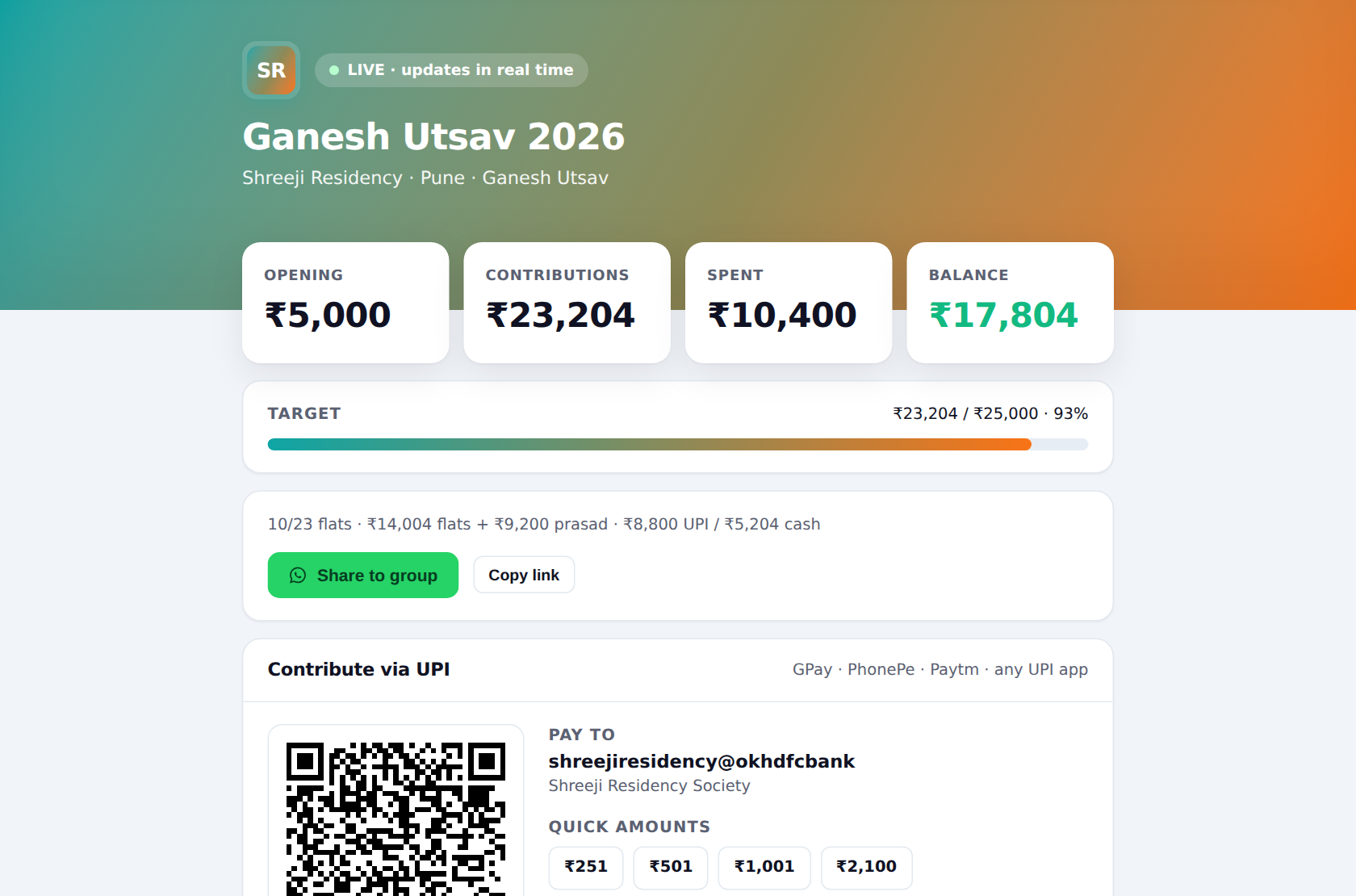
A transparency ledger dissolves the gap: a page any resident can open — every collection with its flat and receipt, every expense with its bill — updated live, gated by a society PIN if you prefer. Not a report about the money. The money, visible.
What goes wrong today
Opacity punishes honest committees
Clean books that nobody can see earn the same suspicion as cooked ones. Volunteers quit over accusations a ledger would have prevented.
Information requests become friction
Each "can I see the accounts?" is an event: finding the register, choosing what to show, wondering why they asked.
The AGM is too late
Questions that could have been answered in October explode in March. Annual disclosure means annual conflict.
Selective sharing breeds doubt
A summary in the group chat, curated by the committee, convinces no sceptic. Totals without detail read as hiding.
What good looks like
Default-open, always current
The ledger is generated from the live records — the same data the committee works on — so it cannot drift from reality or go stale.
Detail, not summaries
Per-collection and per-expense rows with receipts and bill photos. Sceptics can drill down until the doubt runs out.
Scoped the society's way
Fully public, or behind a society PIN shared with residents — openness with a boundary, chosen by the committee.
Answers before questions
When checking is easier than asking, most questions are never asked. The ledger absorbs suspicion silently, every day.
Where Zenia fits
Frequently asked questions
Is a public ledger safe? What about privacy?
The ledger shows society-level financial facts — flats, amounts, purposes — not personal data beyond what a register would hold. Societies that prefer a boundary enable the PIN, sharing it with residents only.
Won't residents misread raw entries?
The opposite happens in practice: raw entries with proof are harder to misread than summaries. And when a genuine error is spotted early by a resident, it is fixed in days, not discovered at audit.
Can the committee edit the ledger to look good?
Entries can be corrected through the app's flows, but an audit log records every action, and receipts already shared with residents don't vanish. The design assumes scrutiny.
Keep reading
Or explore the festival directory — the deep guides behind India's celebrations.