Society accounting software that a volunteer can actually run
Double-entry is for auditors. Complete-entry is for committees.
Society accounting fails at capture, not at classification. Auditors can classify anything — what they cannot do is conjure the ₹35,000 of door-to-door chanda that was collected across six evenings by four volunteers and recorded nowhere.
So the right software for a committee optimises the unglamorous end: making sure every rupee that moves gets recorded at the moment it moves, with enough detail (flat, payer, mode, collector, bill) that the books assemble themselves.
What goes wrong today
Capture leaks at the edges
Door collections, small vendor payments, festival-day cash — the transactions least likely to be written down are the ones auditors ask about.
The treasurer becomes a bottleneck
Everything routes through one person's notebook. When they are busy, records queue in pockets and memories.
Proof is scattered
Bills in a drawer, screenshots in a chat, receipts in a book. Assembling one festival's file takes a weekend.
Year-end is reconstruction
The audit becomes forensic: rebuilding what happened from bank statements and recollection, instead of reading what was recorded.
What good looks like
Record where money moves
Any authorised volunteer records collections at the door from their own phone; expenses are logged with the bill photographed on the spot.
Every entry carries its evidence
Collections link a flat, payer name, mode and receipt; expenses carry a head and a bill image; optional photo proof seals cash payments.
Books that are always closed
Because entries are complete at capture, there is no month-end "closing" — the ledger is current every evening, per event and overall.
An audit trail underneath
Who recorded, who edited, who deleted — logged. The system defends the committee because it remembers everything.
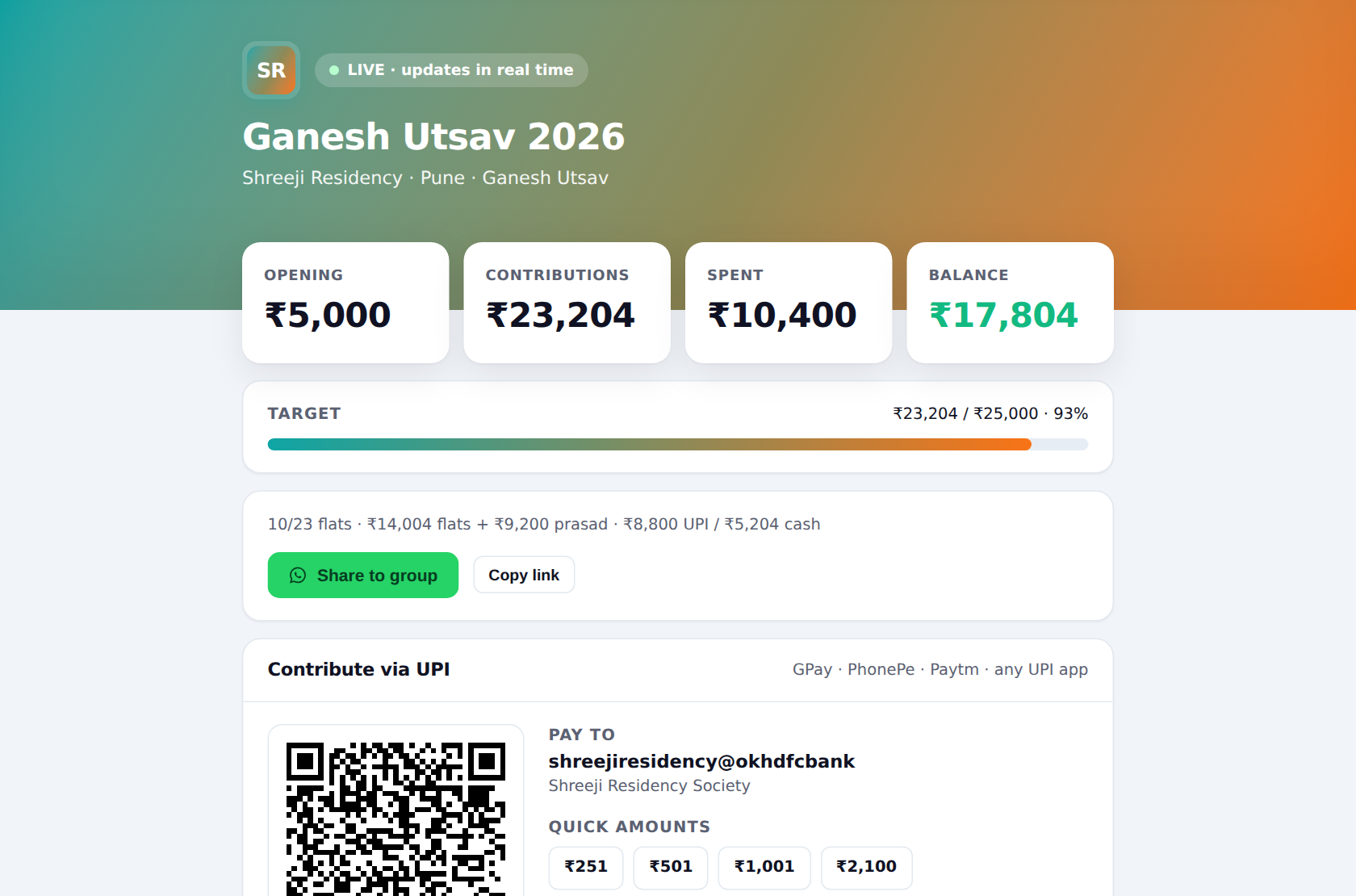
Where Zenia fits
Frequently asked questions
Does Zenia do formal double-entry bookkeeping?
No — and deliberately so. It maintains a complete single-entry money trail (every inflow and outflow, with proof), which is what committees can sustain and what accountants actually need as input for statutory books.
Can we track different funds separately?
Yes. Each event — Navratri chanda, maintenance, corpus drive — has its own collections, expenses and running balance, so funds never blur into each other.
How do bills and proofs get stored?
Photograph the bill while logging the expense; it is stored with the entry and visible on the ledger. Payment-side photo proof can be captured at the door too.
Keep reading
Or explore the festival directory — the deep guides behind India's celebrations.