Door-to-door collection app — built for the doorstep, not the desk
Weak network, queue behind you, baby on hip: record it anyway.
Software designed at a desk assumes time, attention and network. A doorstep has none of the three. The resident is holding dinner, the lift lobby has one bar of signal, and two more volunteers are waiting on the stairs.
A door-to-door collection app must be engineered for that moment: minimum taps, zero typing where possible, graceful offline behaviour, and honest handling of the doors that don't open.
What goes wrong today
Forms designed for desks
Ten fields, two dropdowns and a date picker — at a doorstep. Volunteers give up and go back to the slip of paper.
Basement and stairwell dead zones
The app that needs live network fails exactly where collection happens — lift lobbies, lower floors, parking levels.
No language for closed doors
Paper has no tidy way to say "locked, retry Sunday". So closed doors are remembered, or forgotten, individually.
Mistakes are permanent or invisible
Marked the wrong flat? On paper you overwrite history; in bad apps you can't fix it at all. Both corrode trust in the record.
What good looks like
Three taps to the flat
Block → floor → flat, big touch targets, the app remembering where you are between doors. Amount, mode, done.
Offline is a feature, not an error
No network? The entry queues on the phone with a visible badge and syncs itself later — exactly once, never duplicated.
One-tap outcomes for every door
Locked, not available, visit later — recorded without amounts, reversible when the owner opens the gate late.
Reversible, audited corrections
Wrong flat or wrong amount gets fixed through proper flows that keep the trail — no whiteout, no stuck errors.
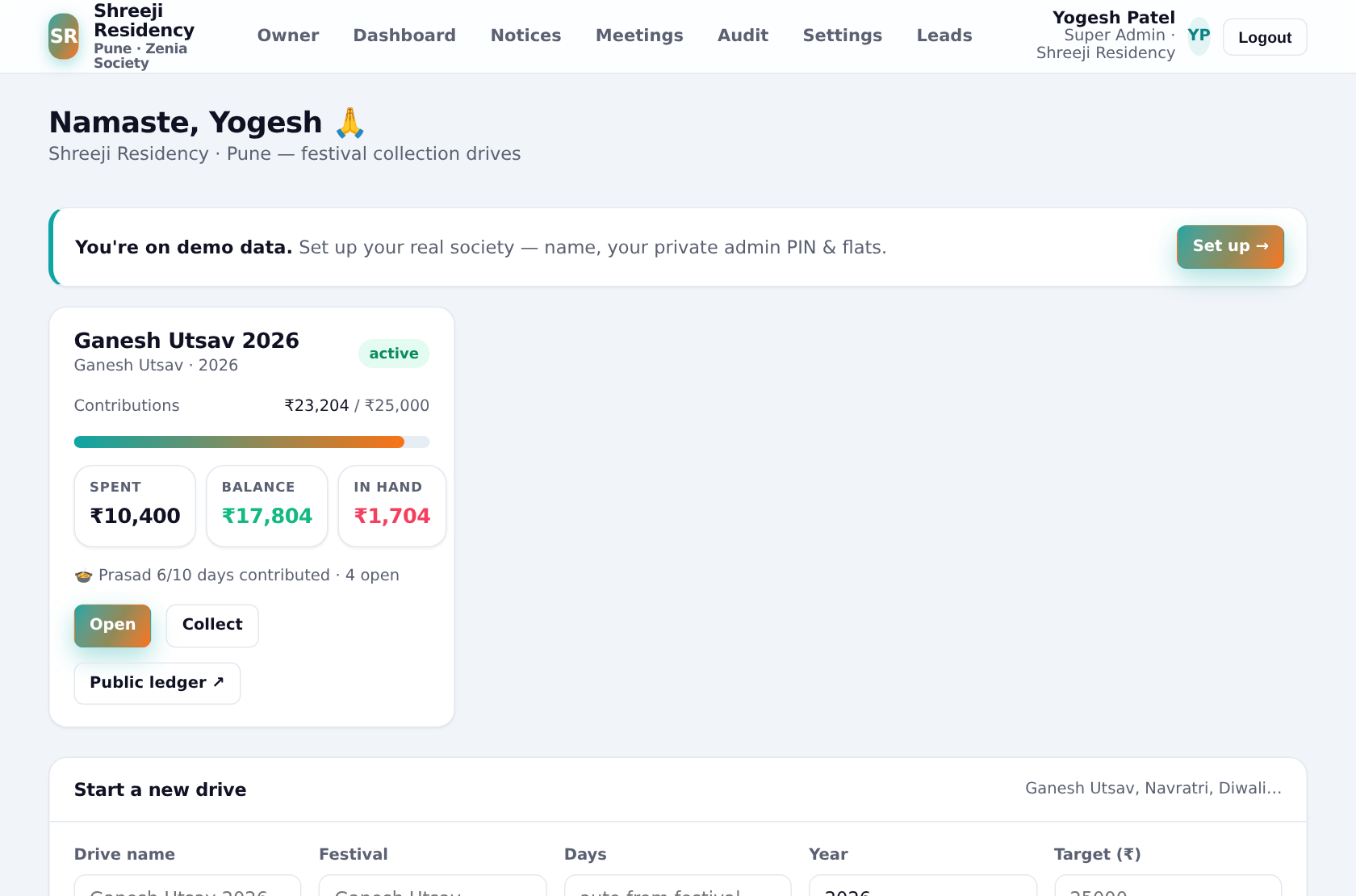
Where Zenia fits
Frequently asked questions
How does offline collection actually work?
The entry is saved to the phone's local queue instantly and flagged "queued on phone" on the grid. When network returns, it syncs with a unique key so retries can never create duplicates. Volunteers just keep collecting.
What if two volunteers reach the same flat?
The live grid shows a flat as paid the moment either records it — and queued entries are badged too, so the second volunteer sees it before knocking.
Can a mistaken "not available" be undone?
Yes — tap the mark again and it clears, or simply record the payment when the door opens; the payment automatically replaces the visit mark. One-tap marks are deliberately reversible.
Keep reading
Or explore the festival directory — the deep guides behind India's celebrations.