Apartment ERP software: do you really need an ERP?
ERP is a factory word. Most societies need a ledger, not a factory.
"ERP" migrated from factories to real estate marketing because it sounds serious. Enterprise Resource Planning was invented to coordinate procurement, production and payroll across departments. A housing society has no production line — it has money coming in from flats and going out to vendors, and records that must stay true.
Calling society software "ERP" mostly signals price. Before buying one, it is worth asking which enterprise resources you are planning.
What goes wrong today
ERP pricing for ledger problems
Implementation fees, per-module licences, annual maintenance contracts — factory economics applied to a volunteer committee's bookkeeping.
Complexity as a feature
Chart-of-accounts trees, cost centres, approval workflows. Impressive until the treasurer — a retired teacher volunteering her evenings — has to close the month.
Implementation never ends
ERPs assume a trained back office. Societies have rotating volunteers; every committee change is a re-implementation.
Reports nobody asked for
Forty canned reports, none of which answer the only real question: "show me every rupee of the Diwali fund, with bills".
What good looks like
Name the actual requirement
For 9 in 10 societies it is: collect, receipt, spend with proof, show residents. That is a transparent ledger system, not an ERP.
Optimise for the doorstep
The system's hardest moment is a volunteer at flat 1302 with weak network and a queue behind them — not a quarterly report. Choose for that moment.
Let the CA handle CA things
Statutory filings and audit formats are your auditor's craft. Feed them a clean, complete ledger and they need nothing "enterprise".
Keep the cost at zero where possible
The ledger-and-receipts layer has free, purpose-built options. Spend society money on the building, not the bookkeeping.
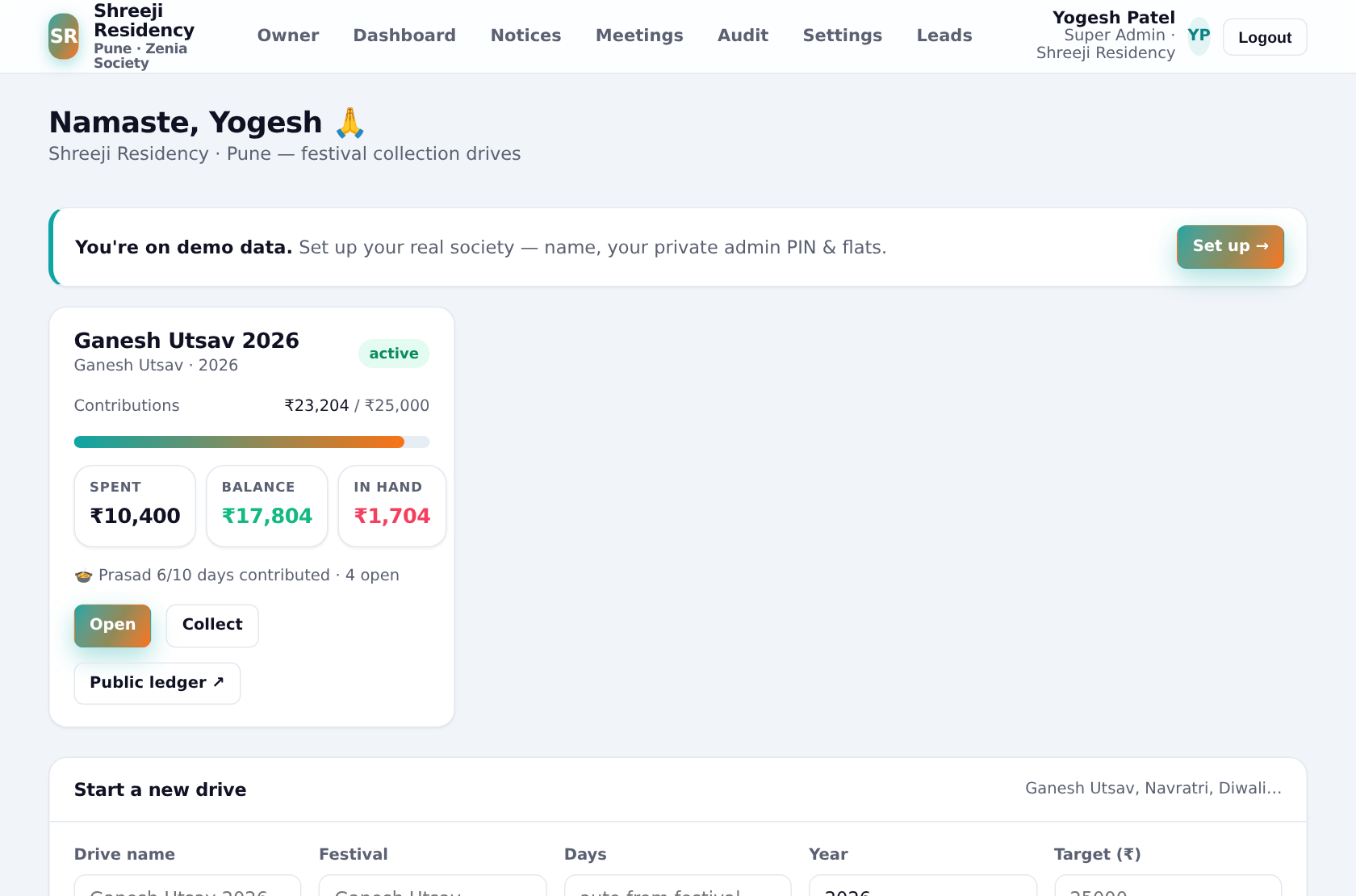
Where Zenia fits
Frequently asked questions
When does a society genuinely need ERP-grade software?
Roughly: multiple employed staff on payroll, several bank accounts, lakhs in monthly vendor procurement, and statutory complexity like GST on amenities. That describes large townships — not typical societies.
Can Zenia's records be used for audits?
Yes — every collection has a date, flat, payer, mode and receipt; every expense has a head and bill photo; and the audit log records who did what. Auditors get a complete, chronological money trail.
What about accounting software like Tally?
Many auditors keep the statutory books in Tally regardless of what the society uses day-to-day. Zenia's job is upstream: making sure what reaches the books is complete and true.
Keep reading
Or explore the festival directory — the deep guides behind India's celebrations.